Memo · November 8, 2026
Overbuild, Collapse, Win Anyway
What the railroads, the dynamo and dark fiber say about AI, energy and the price of intelligence
Every general-purpose infrastructure revolution since the canals has followed one script. Financial capital overbuilds the network. The price of what it produces collapses. Usage explodes anyway. The builders go bankrupt or get consolidated. Productivity arrives a generation late. And the fortunes go to whoever owns what the revolution made scarce, not to whoever sold what it made cheap. AI is following the script. The one new variable is that this cycle's scarce input is electricity.
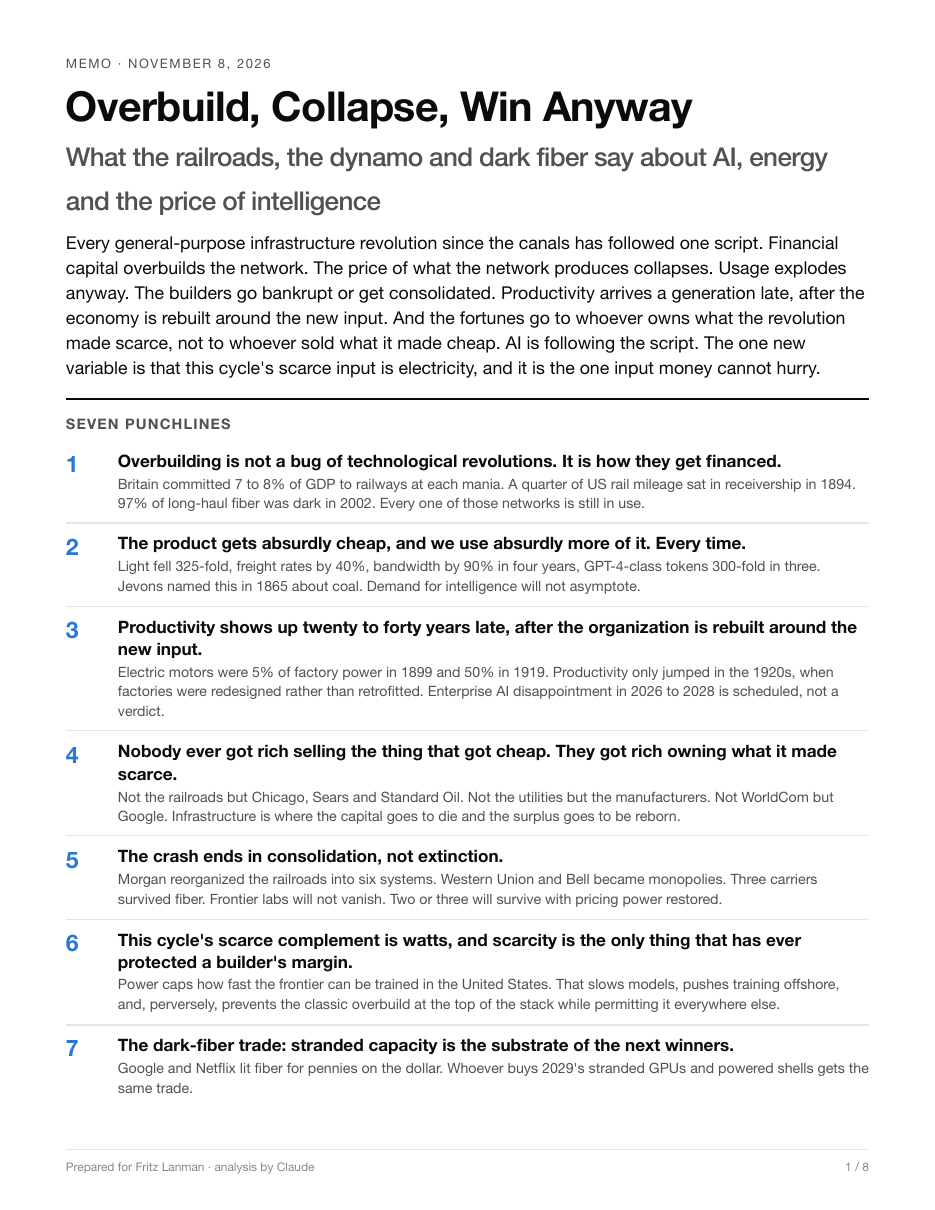
Seven punchlines
- 1Overbuilding is not a bug of technological revolutions. It is how they get financed.Britain committed 7 to 8% of GDP to railways at each mania. A quarter of US rail mileage sat in receivership in 1894. 97% of long-haul fiber was dark in 2002. Every one of those networks is still in use.
- 2The product gets absurdly cheap, and we use absurdly more of it. Every time.Light fell 325-fold, freight rates by 40%, bandwidth by 90% in four years, GPT-4-class tokens 300-fold in three. Jevons named this in 1865 about coal.
- 3Productivity shows up twenty to forty years late, after the organization is rebuilt around the new input.Electric motors were 5% of factory power in 1899 and 50% in 1919. Productivity jumped only in the 1920s. Enterprise AI disappointment in 2026 to 2028 is scheduled, not a verdict.
- 4Nobody ever got rich selling the thing that got cheap. They got rich owning what it made scarce.Not the railroads but Chicago, Sears and Standard Oil. Not the utilities but the manufacturers. Not WorldCom but Google.
- 5The crash ends in consolidation, not extinction.Morgan reorganized the railroads into six systems. Three carriers survived fiber. Two or three frontier labs will survive with pricing power restored.
- 6This cycle's scarce complement is watts, and scarcity is the only thing that has ever protected a builder's margin.Power caps how fast the frontier can be trained in the United States. That slows models, pushes training offshore, and prevents the classic overbuild at the top of the stack while permitting it everywhere else.
- 7The dark-fiber trade: stranded capacity is the substrate of the next winners.Google and Netflix lit fiber for pennies on the dollar. Whoever buys 2029's stranded GPUs and powered shells gets the same trade.
Fritz Lanman, with analysis by Claude. Historical series are approximate and indexed; probabilities and scenario curves are the author's own. Sources are listed on the memo's last page.